Steering Long Sessions
A handful of habits for handling long Claude Code sessions without babysitting every step of it:
- Scope you work first, then
- Steer
- Direct your compaction so the summary keeps what matters.
- Use the rewind menu to course correct when Claude drifts.
- Set a goal when you can describe “done” better than you can describe the steps.
- Use loop for waiting on something outside the session.
- Run parallel work in worktrees.
Scope the Work First with Plan Mode
Before Claude writes a single line, get it to lay out a plan. In plan mode, Claude does its research in read-only mode. It reads the code, figures out what needs to change, and hands you a plan to review.
When you get that plan, actually read it. Don’t skim it.
- The more thorough the plan, the fewer surprises you’ll hit once Claude starts executing.
- If something’s off or missing, just ask Claude to add it where you want.
Iterating on a plan is much faster than letting Claude run and hoping for the best, then cleaning up the mess!
Steer While Claude Works
Once Claude is running, you have a few ways to keep it pointed in the right direction.
Compact
Compact summarizes your conversation, uses that summary as the new context, and deletes the old messages.
- This frees up your context window so Claude can keep going.
- Risk: Something important may get dropped in the summary, and Claude drifts off course.
Don’t just run /compact on its own. Add instructions after the command to tell Claude how to summarize. Anything you write after the command shapes what the summary keeps. That’s your steering wheel for context.
Example
For example, if you finished debugging a while back and now you only care about some API changes, say so:
/compact Focus on the --version flag implementation
Python Analogy
# context window filling up
messages = [setup, debugging..., api_work...]

# bare /compact: the summarizer decides what matters
messages = [summarize(messages)]

# directed /compact: you pass a parameter
messages = [summarize(messages, focus="--version flag implementation")]
Rewind
When Claude heads down the wrong path, you don’t have to prompt your way back out.
Rewind takes you to your last checkpoint. (Every user prompt creates a checkpoint you can revert to. )
To open the menu, double tap escape on an empty prompt.
From the rewind menu you get a few options:
- Restore code and conversation: Roll back both together.
- Restore conversation: Roll back just the chat.
- Restore code: Roll back just the files.
- Summarize from here: Summarizes everything after the checkpoint. Great if you had a side conversation and just want to free up some space.
- Summarize up to here: Summarizes everything before the checkpoint. Great when you had a long setup phase you want to compress, but you want to keep the implementation parts intact.
Python Analogy
checkpoints = []

def on_user_prompt(prompt):
    checkpoints.append(copy.deepcopy((conversation, code)))   # one per prompt
    ...

def rewind(i, restore="both"):
    conv, code = checkpoints[i]
    if restore in ("both", "conversation"): conversation[:] = conv
    if restore in ("both", "code"):         files[:] = code
Let Claude run more autonomously
Goal
Goal sets a completion condition. You describe what “done” looks like, and Claude keeps working across turns until a fast evaluator confirms those conditions are met. It won’t just stop the first time it thinks it’s finished.
Example:
/goal all tests in src/billing pass, and the type checker reports zero errors
To cancel it, run /goal clear.
One important constraint: the evaluator only reads the transcript. So your condition has to be checkable from the output Claude actually produces, like the results of a test run.s
Loop
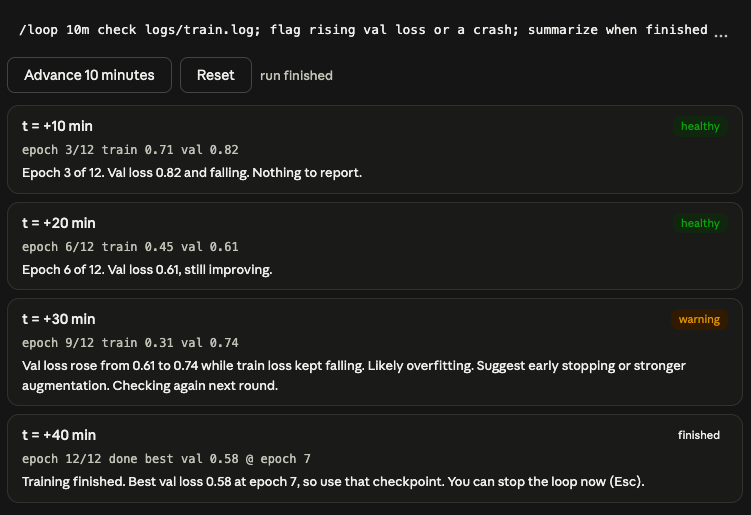
Loop runs a prompt on an interval between turns, either fixed or self-paced.
Use it to pull something external, like a CI run or a deploy, and act when the state changes.
To stop a loop, just press escape.
Example: Check model training log every 10 minutes.
Python analogy
while True:                          # Esc stops it
    log = read("logs/train.log")
    report = claude(prompt, log)     # your prompt, run between your turns
    if report.needs_attention:
        notify_you(report)
    time.sleep(interval)             # fixed ("10m") or chosen by Claude
Run parallel work with worktrees
When you’re running multiple agents on the same codebase, it could happen that two Claude sessions fighting over the same files leads to conflicts - that’s unsafe!
That’s where worktrees come in: Instead of sessions stepping on each other, each one gets its own independent file tree.
- Because each agent has its own tree, they can’t clobber each other’s changes.
- When a session exits, a clean worktree is automatically removed.
A .worktreeinclude file at the repo root lists git-ignored files to copy into each worktree. This is useful for things like an environment variable file or a local config that you need in every worktree but don’t want to commit to version control.