Part-of-Speech Tagging
Parts of speech (a.k.a POS, word classes, or syntactic categories) are useful because they reveal a lot about a word and its neighbors
E.g.: Knowing whether a word is a noun or a verb tells us about likely neighboring words
Style Convention
Bold:
new terms/concept/definition
important points
Italic: examples
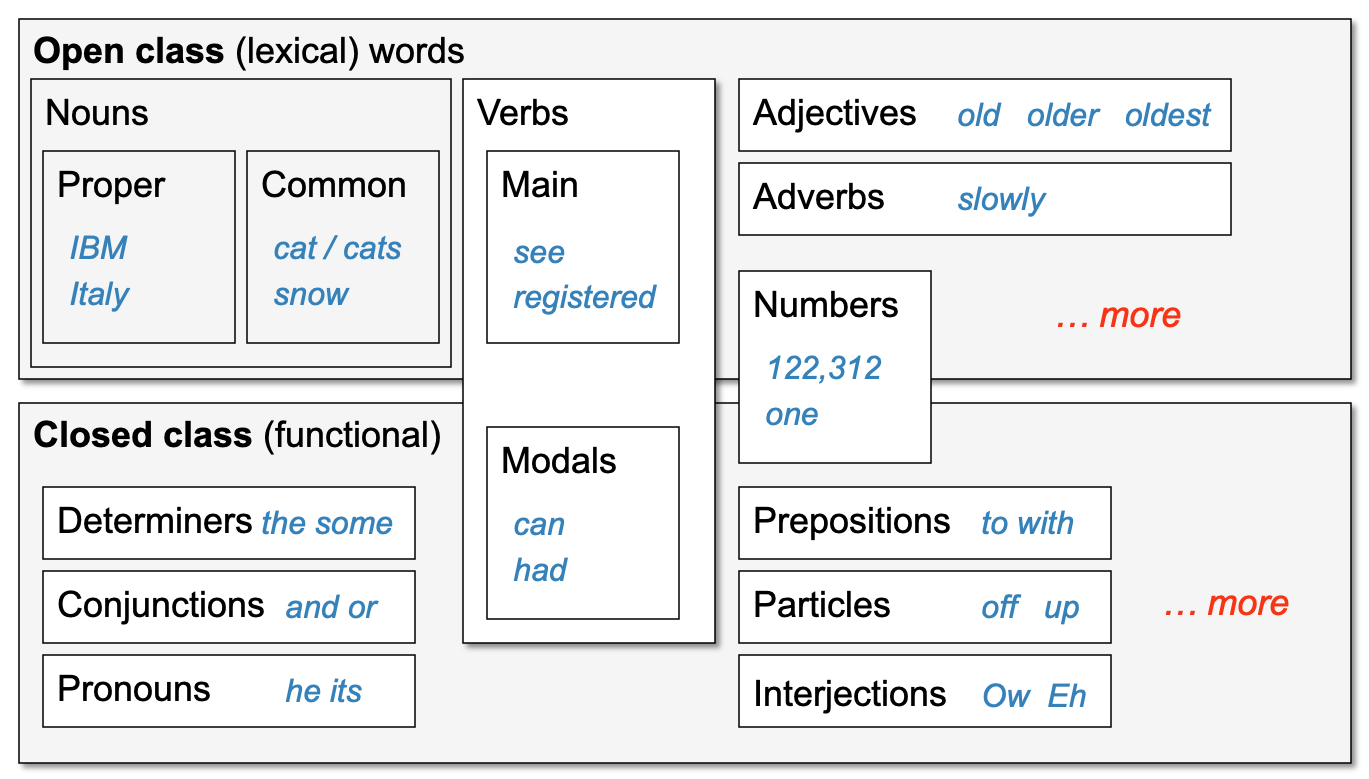
(Mostly) English Word Classes
Parts of Speech
closed class
close $\equiv$ relatively fixed membership
Generally function words, which
- tend to be very short
- occur frequently
- often have structuring uses in grammar
Important closed class in English:
Prepositions (介词)
- on, under, over, near, by, at, from, to, with
- Occur before noun phrases
- Often indicate spatial or temporal relations
- literal (on it, before then, by the house)
- metaphorical (on time, with gusto, beside herself)
- Also indicate other relations
- Hamlet was written by Shakespeare
Particle (小品词)
- up, down, on, off, in, out, at, by
- Resembles a preposition or an adverb
- Used in combination with a verb
- Particles often have extended meanings that aren’t quite the same as the prepositions they resemble
Determiner (限定词)
- Occurs with nouns, often marking the beginning of a noun phrase
- article (冠词)
- indefinite: a, an
- definite: the
- Other determiner: this, that (this chapter, that page)
- article (冠词)
- Occurs with nouns, often marking the beginning of a noun phrase
Conjunctions (连词): join two phrases, clauses, or sentences
- Coordinating conjunctions: join two elements of equal status
- and, or, but
- Subordinating conjunctions: when one of the elements has some embedded status
- I thought that you might like some milk
- main clause: I thought
- subordinate clause: you might like some milk
- Subordinating conjunctions like that which link a verb to its argument in this way are also called complementizers.
- I thought that you might like some milk
- Coordinating conjunctions: join two elements of equal status
Pronouns (代词): often act as a kind of shorthand for referring to some noun phrase or entity or event
- Personal pronouns (人称代词): refer to persons or entities
- you, she, I, it, me, etc
- **Possessive pronouns ** (物主代词): forms of personal pronouns that indicate either actual possession or more often just an abstract relation between the person and some object
- my, your, his, her, its, one’s, our, their
- Wh-pronouns: are used in certain question forms
- what, who, whom, whoever
- may also act as complementizers
- Frida, who married Diego. . .
- Personal pronouns (人称代词): refer to persons or entities
auxiliary verbs (助动词)
- mark semantic features of a main verb
- whether an action takes place in the present, past, or future (tense)
- whether it is completed (aspect)
- whether it is negated (polarity)
- whether an action is necessary, possible, suggested, or desired (mood)
- Copula verb (系动词):
- be
- connects subjects with certain kinds of predicate nominals and adjectives
- He is a duck
- is used as part of the passive (We were robbed) or progressive (We are leaving) constructions
- connects subjects with certain kinds of predicate nominals and adjectives
- have
- mark the perfect tenses
- I have gone
- I had gone
- mark the perfect tenses
- be
- **Modal verbs ** (情态动词): mark the mood associated with the event depicted by the main verb
- can: indicates ability or possibility
- may: indicates permission or possibility
- must: indicates necessity
- There is also a modal use of have (e.g., I have to go).
- mark semantic features of a main verb
open class
- open $\equiv$ words are continually being created or borrowed
- Four major open classes:
- Nouns: include concrete terms (ship and chair), abstractions (bandwidth and relationship), and verb-like terms (pacing as in His pacing to and fro became quite annoying)
- Proper nouns: names of specific persons or entities
- E.g.: Regina, Colorado, IBM
- Generally NOT preceeded by articles
- Regina is upstairs
- Usually capitalized
- Common nouns
- Count nouns
- Allow grammatical enumeration, occurring in both the singular and plural
- goat/goats, relationship/relationships
- Can be counted
- one goat, two goats
- Singular count nouns can NOT appear without articles
Goat is white❌
- Allow grammatical enumeration, occurring in both the singular and plural
- Mass nouns
- something is conceptualized as a homogeneous group
- Can NOT be counted
- snow, salt, and communism
two snows❌
- Can appear without articles
- Snow is white
- Count nouns
- Proper nouns: names of specific persons or entities
- Verbs
- Refer to actions and processes, including main verbs (draw, provide, go)
- Have infections
- non-third-person-sg (eat)
- third-person-sg (eats)
- progressive (eating)
- past participle (eaten)
- Adjectives
- Includes many terms for properties or qualities
- Adverbs: can be viewes as modifying something (often verbs)
- Type:
- Directional/locative adverbs: specify the direction or location of some action
- home, here, downhill
- Degree adverbs: specify the extent of some action. process, or property
- extremely, very, somewhat
- Manner adverbs: describe the manner of some action or process
- slowly, slinkily, delicately
- Temporal adverbs: describe the time that some ac- tion or event took place
- yesterday, Monday
- Directional/locative adverbs: specify the direction or location of some action
- Some adverbs (e.g., temporal adverbs like Monday) are tagged in some tagging schemes as nouns.
- Type:
- Nouns: include concrete terms (ship and chair), abstractions (bandwidth and relationship), and verb-like terms (pacing as in His pacing to and fro became quite annoying)
Many words of more or less unique function
interjections (oh, hey, alas, uh, um),
negatives (no, not),
politeness markers (please, thank you),
greetings (hello, goodbye),
existential there (there are two on the table)
These classes may be distinguished or lumped together as interjections or adverbs depending on the purpose of the labeling.
Summary
The Penn Treebank Part-of-Speech Tagset
45-tag Penn Treebank tagset (Marcus et al., 1993)
Parts of speech are generally represented by placing the tag after each word, delimited by a slash
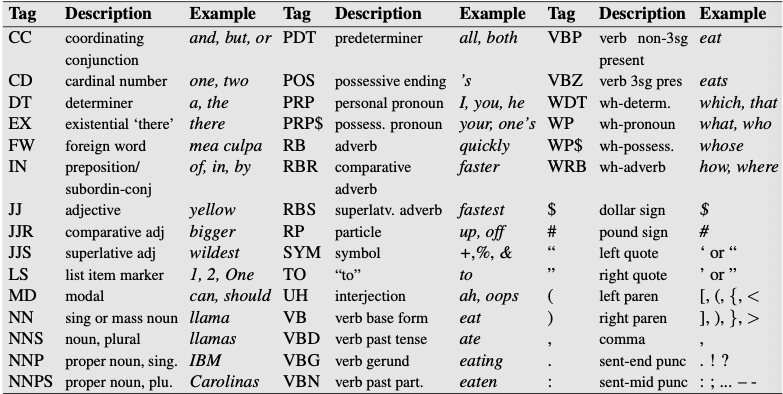
Penn Treebank Part-os-Speech Tagset
Example:
The/DT grand/JJ jury/NN commented/VBD on/IN a/DT number/NN of/IN other/JJ topics/NNS ./.
There/EX are/VBP 70/CD children/NNS there/RB
Preliminary/JJ findings/NNS were/VBD reported/VBN in/IN today/NN
’s/POS New/NNP England/NNP Journal/NNP of/IN Medicine/NNP ./.
Tagged corpora
- Brown corpus
- WSJ corpus
- Switchboard corpus
Part-of-Speech Tagging
Part-of-speech tagging: process of assigning a part-of-speech marker to each word tokens in an input text
Input to a tagging algorithm: a sequence of (tokenized) word in an input text. words and a tagset,
output: a sequence of tags, one per token.
Tagging: disambiguation task
Words are ambiguous: have more than one possible part-of-speech 😧
🎯 Goal: find the correct tag for the situation
E.g.
book can be a verb (book that flight) or a noun (hand me that book)
That can be a determiner (Does that flight serve dinner) or a complementizer (I
thought that your flight was earlier).
The goal of POS-tagging is to resolve these ambiguities, choosing the proper tag for the context. 💪
Most ambiguous frequent words are that, back, down, put and set.
E.g., 6 POS for the word back
earnings growth took a back/JJ seat
a small building in the back/NN
a clear majority of senators back/VBP the bill
Dave began to back/VB toward the door
enable the country to buy back/RP about debt
I was twenty-one back/RB then
Nonetheless, many words are easy to disambiguate, because their different tags aren’t equally likely. This idea suggests a simplistic baseline algorithm for part-of-speech tagging: given an ambiguous word, choose the tag which is most frequent in the training corpus. 💡
Most Frequent Class Baseline: Always compare a classifier against a baseline at least as good as the most frequent class baseline (assigning each token to the class it occurred in most often in the training set).
How good is this baseline?
- Standard way to measure the performance of part- of-speech taggers: accuracy
- the percentage of tags correctly labeled (matching human labels on a test set)
- train on the WSJ training corpus and test on sections 22-24 of the same corpus
- the most-frequent-tag baseline achieves an accuracy of 92.34%.
- the state of the art in part-of-speech tagging on this dataset is around 97% tag accuracy