The Fundamentals - Why Tiny Changes Make a Big Difference
The Surprising Power of Atomic Habits
Why small habits make a big difference
It is so easy to overestimate the importance of one defining moment and underestimate the value of making small improvements on a daily basis.
- Too often, we convince ourselves that massive success requires massive action. We put pressure on ourselves to make some earth-shattering improvement that everyone will talk about.
- Improving by 1 % isn’t particularly notable—sometimes it isn’t even noticeable—but it can be far more meaningful, especially in the long run. The difference a tiny improvement can make over time is astounding.

Habits are the compound interest of self-improvement. The effects of your habits multiply as you repeat them. They seem to make little difference on any given day and yet the impact they deliver over the months and years can be enormous.
We often dismiss small changes because they don’t seem to matter very much in the moment.
We make a few improvements, but the results never seem to come quickly and so we slide back into our previous routines.
- E.g., If you save a little money now, you’re still not a millionaire. If you go to the gym three days in a row, you’re still out of shape. If you study Mandarin for an hour tonight, you still haven’t learned the language.
Unfortunately, the slow pace of transformation also makes it easy to let a bad habit slide!
- E.g., If you eat an unhealthy meal today, the scale doesn’t move much. If you work late tonight and ignore your family, they will forgive you. If you procrastinate and put your project off until tomorrow, there will usually be time to finish it later.
When we repeat 1% errors, day after day, by replicating poor decisions, duplicating tiny mistakes, and rationalizing little excuses, our small choices compound into toxic results!!!
Making a choice that is 1% better or 1% worse seems insignificant in the moment, but over the span of moments that make up a lifetime these choices determine the difference between who you are and who you could be. Success is the product of daily habits—not once-in-a-lifetime transformations.
It doesn’t matter how successful or unsuccessful you are right now. What matters is whether your habits are putting you on the path toward success. You should be far more concerned with your current trajectory than with your current results.
- If you want to predict where you’ll end up in life, all you have to do is follow the curve of tiny gains or tiny losses, and see how your daily choices will compound ten or twenty years down the line. Outcomes lag behind habits.
- Time amplifies whatever you feed it: good habits make time an ally; bad habits make time an enemy.
Your habits can compound for you or against you
| Positive Compounding | Negative Compounding |
|---|---|
| Productivity compounds. The effect of automating an old task or mastering a new skill can be even greater. The more tasks you can handle without thinking, the more your brain is free to focus on other areas. | Stress compounds. |
| Knowledge compounds. | Negative thoughts compound. The more you think of yourself as worthless, stupid, or ugly, the more you condition yourself to interpret life that way. You get trapped in a thought loop. |
| Relationships compound. People reflect your behavior back to you. The more you help others, the more others want to help you. Being a little bit nicer in each interaction can result in a network of broad and strong connections over time. | Outrage compounds. A long series of microaggressions and daily aggravations slowly multiply until one event tips the scales and outrage spreads like wildfire. |
What progress is really like
Breakthrough moments are often the result of many previous actions, which build up the potential required to unleash a major change.
Similarly, habits often appear to make no difference until you cross a critical threshold and unlock a new level of performance.
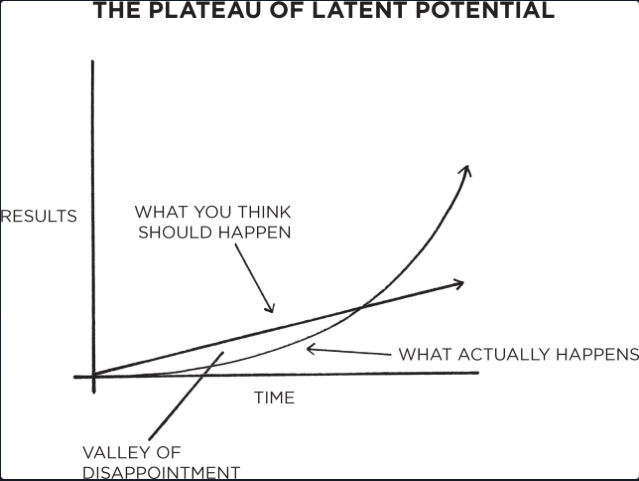
- In the early and middle stages of any quest, there is often a Valley of Disappointment.
- You expect to make progress in a linear fashion and it’s frustrating how ineffective changes can seem during the first days, weeks, and even months.
- It’s a hallmark of any compounding process: the most powerful outcomes are delayed.
- This is one of the core reasons why it is so hard to build habits that last. People make a few small changes, fail to see a tangible result, and decide to stop. But in order to make a meaningful difference, habits need to persist long enough to break through this plateau—the Plateau of Latent Potential.
- If you find yourself struggling to build a good habit or break a bad one, it is not because you have lost your ability to improve. It is often because you have not yet crossed the Plateau of Latent Potential.
- When you finally break through the Plateau of Latent Potential, people will call it an overnight success.
- The outside world only sees the most dramatic event rather than all that preceded it.
- But you know that it’s the work you did long ago—when it seemed that you weren’t making any progress—that makes the jump today possible.
- Mastery requires patience: steady, repeated effort before any crack appears.
Example: Ice melting analogy
Forget about goals, focus on systems instead
Difference between goals and systems: Goals are about the results you want to achieve; systems are about the processes that lead to those results.
Examples
- If you’re a coach, your goal might be to win a championship. Your system is the way you recruit players, manage your assistant coaches, and conduct practice.
- If you’re an entrepreneur, your goal might be to build a million-dollar business. Your system is how you test product ideas, hire employees, and run marketing campaigns.
- If you’re a musician, your goal might be to play a new piece. Your system is how often you practice, how you break down and tackle difficult measures, and your method for receiving feedback from your instructor.
Goals are good for setting a direction, but systems are best for making progress.
A handful of problems arise when you spend too much time thinking about your goals and not enough time designing your systems:
Winners and losers have the same goals.
- Winners and losers typically share the same goals, so goals don’t explain outcomes.
- Survivorship bias makes us credit success to goals while ignoring those with identical goals who failed.
- The goal had always been there. The real differentiator is the system: consistent, continuous small improvements lead to success.
Achieving a goal is only a momentary change
- Hitting a goal creates only a temporary improvement.
- Without changing the underlying habits/system, the old problem returns (You treated a symptom without addressing the cause.).
- We think we need to change our results, but the results are not the problem. What we really need to change are the systems that cause those results.
- When you solve problems at the results level, you only solve them temporarily.
- In order to improve for good, you need to solve problems at the systems level. Fix the inputs and the outputs will fix themselves.
Goals restrict your happiness.
- The implicit assumption behind any goal is this: “Once I reach my goal, then I’ll be happy.” -> A goals-first mindset postpones happiness until a milestone is hit,
- Goals create an “either-or” conflict: either you achieve your goal and are successful or you fail and you are a disappointment. -> You mentally box yourself into a narrow version of happiness.
- Real life rarely matches a single planned outcome, so tying happiness to one result is misguided.
- A systems-first mentality provides the antidote: When you fall in love with the process rather than the product, you don’t have to wait to give yourself permission to be happy. You can be satisfied anytime your system is running.
Goals are at odds with long-term progress.
- A goal-oriented mind-set can create a “yo-yo” effect.
- When all of your hard work is focused on a particular goal, what is left to push you forward after you achieve it? This is why many people find themselves reverting to their old habits after accomplishing a goal.
- The purpose of setting goals is to win the game. The purpose of building systems is to continue playing the game.
- True long-term thinking is goal-less thinking.
- It’s not about any single accomplishment.
- It is about the cycle of endless refinement and continuous improvement. Ultimately, it is your commitment to the process that will determine your progress.
A system of atomic habits
If you’re having trouble changing your habits, the problem isn’t you. The problem is your system.
Bad habits repeat themselves again and again not because you don’t want to change, but because you have the wrong system for change.
You do not rise to the level of your goals. You fall to the level of your systems.
-> Focusing on the overall system, rather than a single goal!
“Atomic habits” are small, 1% improvements that are parts of a larger system—like atoms to molecules. They are simple yet powerful building blocks of compound growth and overall improvement.
💡Take Away
- Habits are the compound interest of self-improvement. Getting 1 percent better every day counts for a lot in the long-run.
- Habits are a double-edged sword. They can work for you or against you, which is why understanding the details is essential.
- Small changes often appear to make no difference until you cross a critical threshold. The most powerful outcomes of any compounding process are delayed. You need to be patient.
- An atomic habit is a little habit that is part of a larger system.
How Your Habits Shape Your Identity (and Vice Versa)
It often feels difficult to keep good habits going for more than a few days, even with sincere effort and the occasional burst of motivation. However, once your habits are established, they seem to stick around forever—especially the unwanted ones.
The first reason why changing our habits is so challenging is that we try to change the wrong thing.
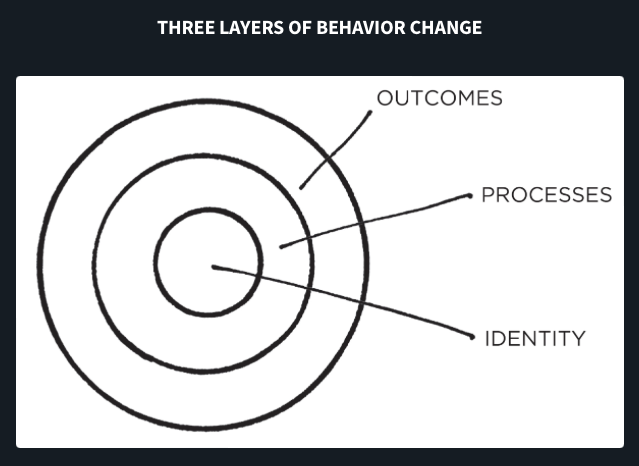
There are three levels at which change can occur:
| Layer | Changing | Note | |
|---|---|---|---|
| 1 | Changing your outcome | This level is concerned with changing your results: losing weight, publishing a book, winning a championship. Most of the goals you set are associated with this level of change. | What you get |
| 2 | Changing your process | This level is concerned with changing your habits and systems: implementing a new routine at the gym, decluttering your desk for better workflow, developing a meditation practice. Most of the habits you build are associated with this level.s | What you do |
| 3 | Changing your identity | This level is concerned with changing your beliefs: your worldview, your self-image, your judgments about yourself and others. Most of the beliefs, assumptions, and biases you hold are associated with this level. | What you believe |
When it comes to building habits that last, the problem is not that one level is “better” or “worse” than another - all levels of change are useful in their own way. The problem is the direction of change: Most people focus on outcomes (goals), which leads to outcome-based habits.
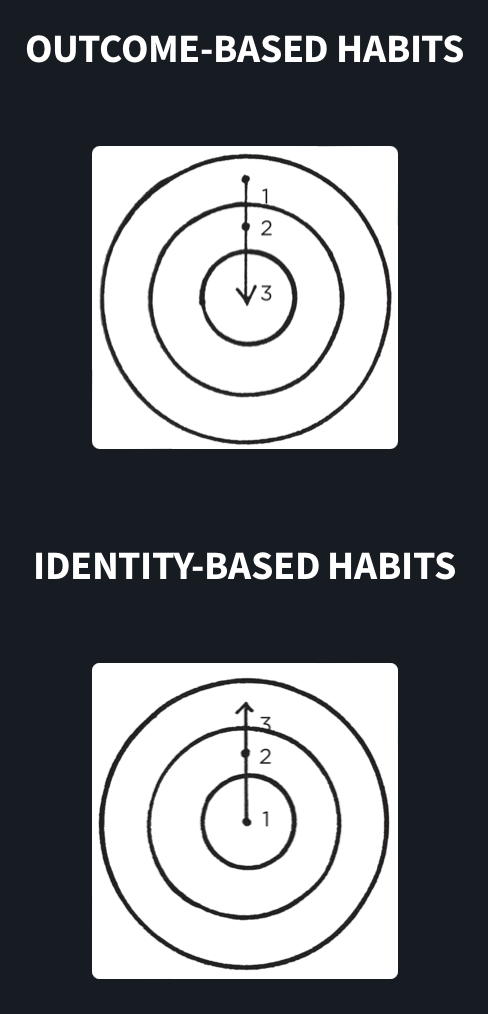
A more durable approach is identity-based habits: Instead of focusing on “What do I want to achieve?” (the result/outcome/goal), begin with focusing on “Who do I want to become?” (the identity).
Lasting habit change requires identity change, not just behavior tweaks.
E.g.: “I’m not a smoker” (identity) beats “I’m trying to quit smoking” (behavioral attempt).
People often over-focus on outcomes/processes and ignore belief systems that drive actions. Their old identity can sabotage their new plans for change.
Behind every system of actions are a system of beliefs.
- Behavior that is incongruent with the self will not last.
- It’s hard to change your habits if you never change the underlying beliefs that led to your past behavior.
The ultimate form of intrinsic motivation is when a habit becomes part of your identity.
Pride reinforces maintenance: The more pride you have in a particular aspect of your identity, the more motivated you will be to maintain the habits associated with it. 💪
True behavior change is identity change. You might start a habit because of motivation, but the only reason you’ll stick with one is that it becomes part of your identity.
The goal is not to… The goal is to… Read a book Become a reader Run a marathon Become a runner Learn an instrument Become a muscian
Your behaviors are usually a reflection of your identity.
- What you do is an indication of the type of person you believe that you are—either consciously or nonconsciously.
- E.g., the person who incorporates exercise into their identity doesn’t have to convince themselves to train.
- When your behavior and your identity are fully aligned, you are no longer pursuing behavior change. You are simply acting like the type of person you already believe yourself to be.
Identity is a double-edged sword - It can powerfully sustain good habits or rigidly block change.
Self-labels repeated over time (like “I’m not a morning person,” “I’m bad at math,” etc.) become mental grooves that guide behavior and resist new actions.
- In time, you begin to resist certain actions because “that’s not who I am.” There is internal pressure to maintain your self-image and behave in a way that is consistent with your beliefs. You find whatever way you can to avoid contradicting yourself.
The more deeply a thought or action is tied to your identity, the more difficult it is to change it.
- The biggest barrier to positive change is identity conflict - Good habits can make rational sense, but if they conflict with your identity, you will fail to put them into action.
-> Over the long run, the real reason you fail to stick with habits is that your self-image gets in the way. 😤
Progress requires unlearning. Becoming the best version of yourself requires you to continuously edit your beliefs, and to upgrade and expand your identity.
The two-step process to changing your identity
Identity is learned and shaped by experience. Your habits are how you embody your identity.
- The more you repeat a behavior, the more you reinforce the identity associated with that behavior. Your identity is literally your “repeated beingness.”
- E.g.: When you train each day, you embody the identity of an athletic person.
Whatever your identity is right now, you only believe it because you have proof of it.
- The more evidence you have for a belief, the more strongly you will believe it.
- Every action is an evidence. As you repeat thess actions, the evidence accumulates and your self-image begins to change.
- The effect of one-off experiences tends to fade away.
- The effect of habits gets reinforced with time -> By virtue of their frequency your habits contribute most of the evidence that shapes your identity.
Habits are the path to changing your identity. The most practical way to change who you are is to change what you do.
- The process of building habits is actually the process of becoming yourself. This is a gradual evolution.
- We do not change by snapping our fingers and deciding to be someone entirely new.
- We change bit by bit, day by day, habit by habit. We are continually undergoing microevolutions of the self.
- Small habits can make a meaningful difference by providing evidence of a new identity.
- Each habit not only gets results but also teaches you something far more important: to trust yourself. You start to believe you can actually accomplish these things.
- You don’t need perfection—just a majority of “votes” for the desired identity.
Two step process
1. Decide the type of person you want to be.
If unclear, start from desired results and work backward, ask yourself: “Who is the type of person that could get the outcome I want?”
- E.g., Who is the type of person that could lose forty pounds? Who is the type of person that could learn a new language?
2. Prove it to yourself with small wins.
Once you have a handle on the type of person you want to be, you can begin taking small steps to reinforce your desired identity.
Acting like the desired person—even in tiny ways—gradually makes you that person.
Habits ↔ identity feedback loop
Habits shape identity, identity shapes habits.
It’s important to let your values, principles, and identity drive the loop rather than your results. The focus should always be on becoming that type of person, not getting a particular outcome.
The real reason habits matter
Identity change is the North Star of habit change.
- The first step is not what or how, but who. You need to know who you want to be.
- Otherwise, your quest for change is like a boat without a rudder.
You have the power to change your beliefs about yourself.
- Your identity is not set in stone.
- You have a choice in every moment. You can choose the identity you want to reinforce today with the habits you choose today.
Better habits aren’t about life hacks or external metrics but about becoming a certain kind of person
- Over time, your habits shape your deepest self-beliefs—you become your habits.
💡Take Away
- There are three levels of change: outcome change, process change, and identity change.
- The most effective way to change your habits is to focus not on what you want to achieve, but on who you wish to become.
- Your identity emerges out of your habits. Every action is a vote for the type of person you wish to become.
- Becoming the best version of yourself requires you to continuously edit your beliefs, and to upgrade and expand your identity.
- The real reason habits matter is not because they can get you better results (although they can do that), but because they can change your beliefs about yourself.
How to Build Better Habits in 4 Simple Steps
“Behaviors followed by satisfying consequences tend to be repeated and those that produce unpleasant consequences are less likely to be repeated.” — Edward Thorndike
Why your brain builds habits
A habit is a behavior that has been repeated enough times to become automatic.
The process of habit formation begins with trial and error.
- Whenever you encounter a new situation in life, your brain has to make a decision: “ How do I respond to this?”
- The first time you come across a problem, you’re not sure how to solve it.
- Neurological activity in the brain is high during this period.
- You are carefully analyzing the situation and making conscious decisions about how to act.
- You’re taking in tons of new information and trying to make sense of it all.
- The brain is busy learning the most effective course of action.
- When a rewarding solution appears, the brain tags the preceding cues and actions.
-> This is the feedback loop behind all human behavior: try, fail, learn, try differently.
With practice, the useless movements fade away and the useful actions get reinforced – That’s a habit forming.
- Whenever you face a problem repeatedly, your brain begins to automate the process of solving it.
- Your habits are just a series of automatic solutions that solve the problems and stresses you face regularly.
As habits are created, the level of activity in the brain decreases ⬇️.
- You learn to lock in on the cues that predict success and tune out everything else.
- When a similar situation arises in the future, you know exactly what to look for. There is no longer a need to analyze every angle of a situation.
- Your brain skips the process of trial and error and creates a mental rule: if this, then that. These cognitive scripts can be followed automatically whenever the situation is appropriate.
Habits are mental shortcuts learned from experience.
- A habit is just a memory of the steps you previously followed to solve a problem in the past.
- Whenever the conditions are right, you can draw on this memory and automatically apply the same solution.
Habit formation is incredibly useful because the conscious mind is the bottleneck of the brain.
- Your brain is always working to preserve your conscious attention for whatever task is most essential.
- Whenever possible, the conscious mind likes to pawn off tasks to the nonconscious mind to do automatically.
- Habits reduce cognitive load and free up mental capacity, so you can allocate your attention to other tasks.
(Good) Habits do NOT restrict freedom, they create it.
People who don’t have their habits handled are often the ones with the least amount of freedom.
Example
- Without good financial habits, you will always be struggling for the next dollar.
- Without good health habits, you will always seem to be short on energy.
- Without good learning habits, you will always feel like you’re behind the curve.
Building solid habits lets you create the mental space needed for free thinking and creativity, and focus on creativity, new challenges, and future goals.
The science of how habits work
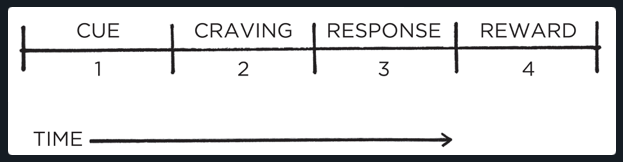
The process of building every habit can be divided into four simple steps: cue, craving, response, and reward.
Cue
Noticing the reward
- The cue triggers your brain to initiate a behavior. It is a bit of information that predicts a reward.
- Your mind is continuously analyzing your internal and external environment for hints of where rewards are located.
- The cue is the first indication that we’re close to a reward, it naturally leads to a craving.
Craving
Wanting the reward
- Craving are the motivational force behind every habit. Without some level of motivation or desire—without craving a change—we have no reason to act.
- We crave not the habit itself but the state change it delivers (e.g., relief, cleanliness, entertainment). Every craving is linked to a desire to change your internal state.
- Cravings vary by individual; different people respond to different cues.
- Cues are meaningless until interpreted by the observer’s thoughts, feelings, and emotions.
Response
Obtaining the reward
- The response is the actual habit you perform, which can take the form of a thought or an action.
- The response occurs only if motivation outweighs the behavior’s friction/effort.
- Ability constraints matter: a habit can form only if you can physically/mentally do it.
Reward
Rewards are the end goal of every habit. We chase rewards because they serve two purposes:
- Rewards satisfy our craving - rewards deliver contentment and relief from craving.
- Rewards teach us which actions are worth remembering in the future.
- Your brain is a reward detector. Your sensory nervous system is continuously monitoring which actions satisfy your desires and deliver pleasure.
- Feelings of pleasure and disappointment are part of the feedback mechanism that helps your brain distinguish useful actions from useless ones.
- Rewards close the feedback loop and complete the habit cycle.
If a behavior is insufficient in any of the four stages, it will NOT become a habit.
- Eliminate the cue and your habit will never start.
- Reduce the craving and you won’t experience enough motivation to act.
- Make the behavior/response difficult and you won’t be able to do it.
- If the reward fails to satisfy your desire, then you’ll have no reason to do it again in the future.
The habit loop
These four steps form a neurological feedback loop, known as the habit loop
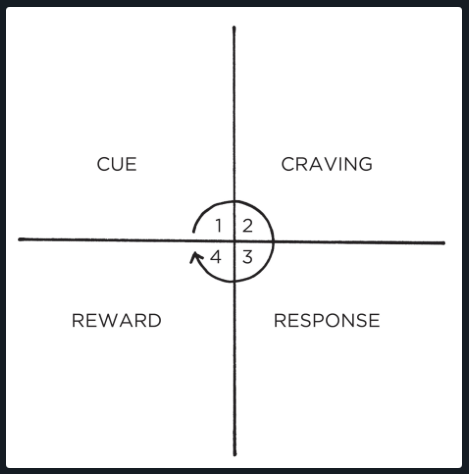
The cue triggers a craving, which motivates a response, which provides a reward, which satisfies the craving and, ultimately, becomes associated with the cue.
It is an endless feedback loop that is running and active during every moment: The brain is continually scanning the environment, predicting what will happen next, trying out different responses, and learning from the results.
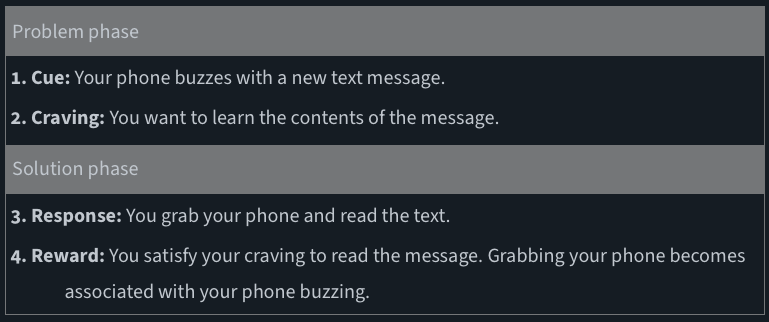
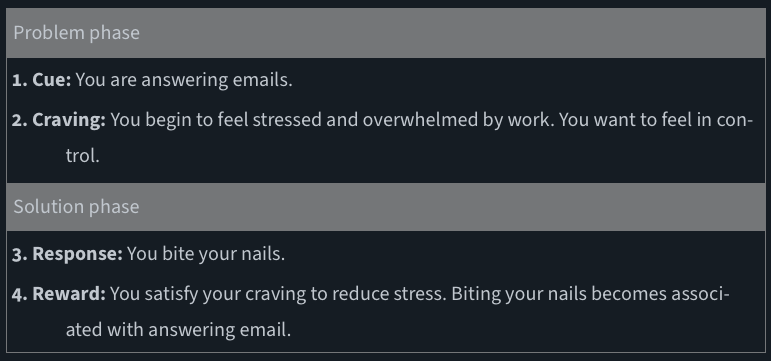
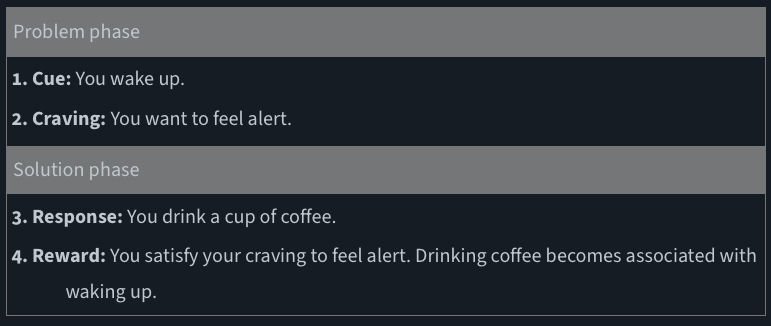
These four steps can be split into two phases
| Phase | Steps | When |
|---|---|---|
| Problem phase | 1. Cue 2. Craving | When you realize that something needs to change |
| Solution phase | 3. Response 4. Reward | When you take action and achieve the change you desire |
Example 1
Example 2
Example 3
Example 4
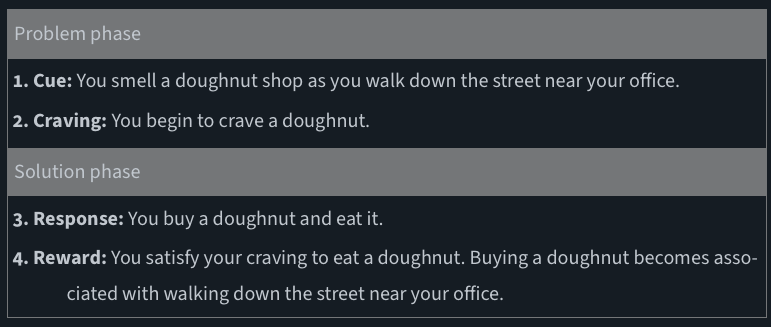
Example 5
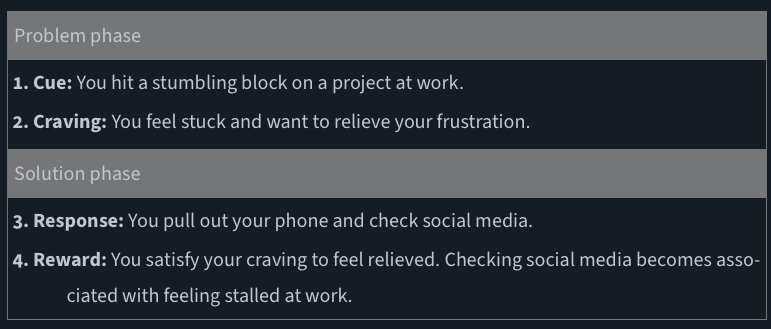
Example 6
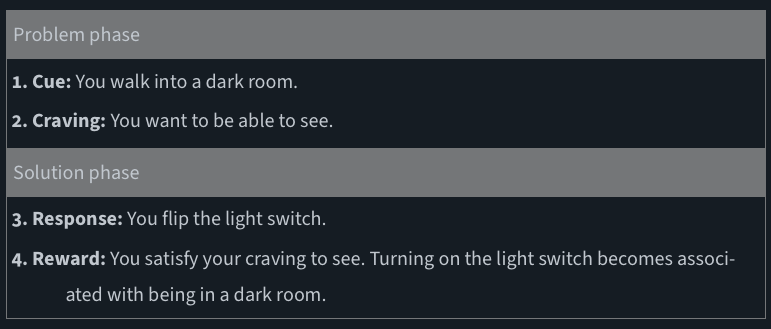
| Phase | Step | Relationship to reward | Note | Example |
|---|---|---|---|---|
| Problem phase | Cue | Noticing the reward | A bit of information that predicts a reward, which triggers your brain to initiate a behavior | You walk into a dark room. |
| Problem phase | Craving | Wanting the reward (desire) | You want to be able to see. | |
| Solution phase | Response | Obtaining the reward | You flip the light switch. | |
| Solution phase | Reward | The end goal of every habit. We chase rewards because they serve two purposes: | You satisfy your craving to see. Turning on the light switch becomes associated with being in a dark room. |
The four laws of behavior change
This framework is called Four Laws of Behavior Change, which provides a simple set of rules for creating good habits and breaking bad ones.
- Each law acts as a lever that influences human behavior.
- When the levers are in the right positions, creating good habits is effortless. When they are in the wrong positions, it is nearly impossible.
| Step | Laws to create a good habit | Break a bad habit |
|---|---|---|
| Cue | Make it obvious. | Make it invisible. |
| Craving | Make it attractive. | Make it unattractive. |
| Response | Make it easy. | Make it difficult. |
| Reward | Make it satisfying. | Make it unsatisfying. |
The key to creating good habits and breaking bad ones is to understand these fundamental laws and how to alter them to your specifications. Every goal is doomed to fail if it goes against the grain of human nature.
💡Take Away
- A habit is a behavior that has been repeated enough times to become automatic.
- The ultimate purpose of habits is to solve the problems of life with as little energy and effort as possible.
- Any habit can be broken down into a feedback loop that involves four steps: cue, craving, response, and reward.
- The Four Laws of Behavior Change are a simple set of rules we can use to build better habits. They are
- make it obvious
- make it attractive
- make it easy
- make it satisfying