The 1st Law - Make it Obvious
TL;DR
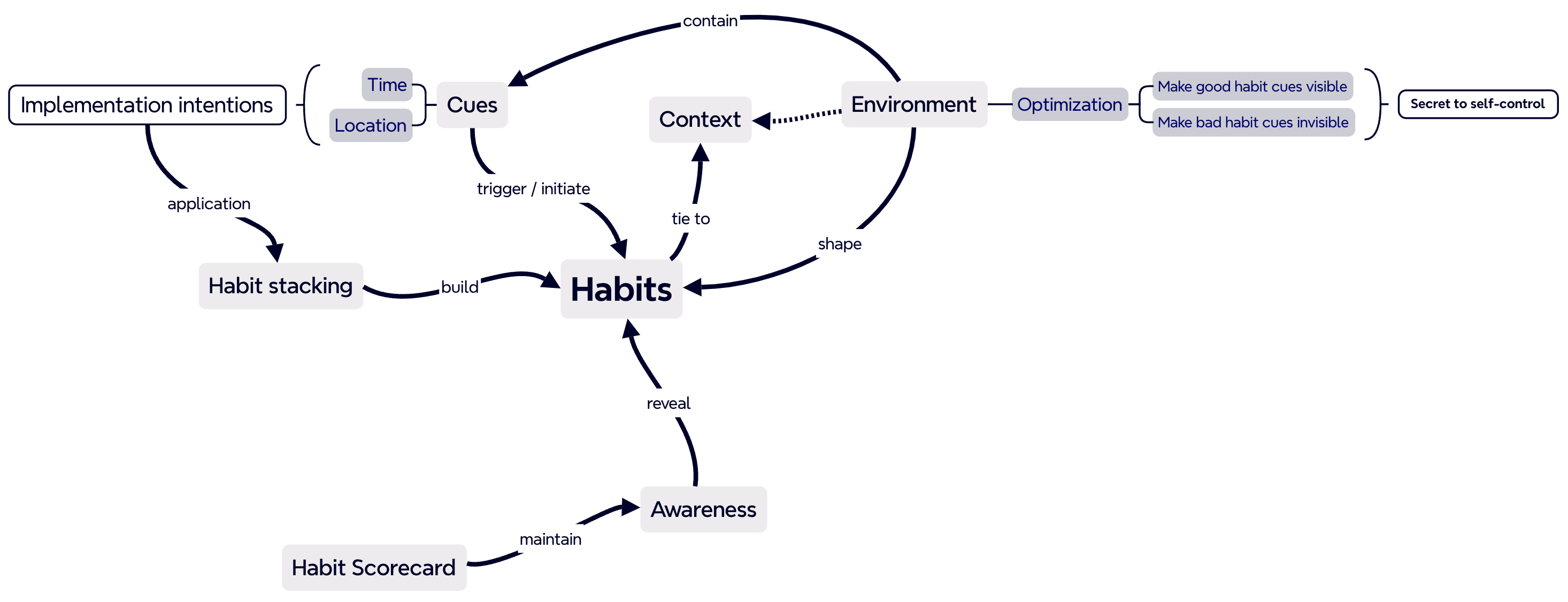
4 major steps to “make it obvious”
- Become aware of your current habtis using Habit Scorecard
- Make new habits specific and clear with Implementation Intention:
I will [BEHAVIOR] at [TIME] in [LOCATION]. - Anchor new habits seamlessly to existing ones using Habit Stacking
- Optimize your environment to make cues for good habit visible
- The secret of self-control: Reduce temptation in the environment, and rely less on self-control by removing cues for bad habits
From Autopilot to Awareness
The human brain is a prediction machine.
- It is continuously taking in your surroundings and analyzing the information it comes across.
- Whenever you experience something repeatedly, your brain begins noticing what is important, sorting through the details and highlighting the relevant cues, and cataloging that information for future use.
With enough practice, you can pick up on the cues that predict certain outcomes without consciously thinking about it. Automatically, your brain encodes the lessons learned through experience.
Many actions run on autopilot; cues can trigger habits without conscious awareness.
Habits can be
- Useful: You can notice an opportunity and take action without dedicating conscious attention to it. Or
- Dangerous: Your actions come under the direction of your automatic and nonconscious mind. You fall into old patterns before you realize what’s happening.
Behavior change starts with awareness: make the unconscious conscious.
The habit scorecard
“Pointing-and-Calling” raises awareness and reduces errors by making automatic steps conscious.
The 'Pointing-and-Calling' process of Japanese railway system
As each operator runs the train, they proceed through a ritual of pointing at different objects and calling out commands.
- When the train approaches a signal, the operator will point at it and say, “Signal is green.”
- As the train pulls into and out of each station, the operator will point at the speedometer and call out the exact speed.
- When it’s time to leave, the operator will point at the timetable and state the time.
Out on the platform, other employees are performing similar actions.
- Before each train departs, staff members will point along the edge of the platform and declare, “All clear!” Every detail is identified, pointed at, and named aloud.
This process, known as Pointing-and-Calling, is a safety system designed to reduce mistakes. It seems silly, but it works incredibly well. Pointing-and-Calling reduces errors by up to 85 percent and cuts accidents by 30 percent. The MTA subway system in New York City adopted a modified version that is “point-only,” and “within two years of implementation, incidents of incorrectly berthed subways fell 57 percent.”
The more automatic a behavior becomes, the less likely we are to consciously think about it.
- When we’ve done something a thousand times before, we begin to overlook things - We assume that the next time will be just like the last.
- We’re so used to doing what we’ve always done that we don’t stop to question whether it’s the right thing to do at all. Many of our failures in performance are largely attributable to a lack of self-awareness.
Apply the “point-and-call” system with a Habits Scorecard to maintain awareness of what we are actually doing
- Make a list of your daily habits
- Look at each behavior, and ask yourself, “Is this a good habit, a bad habit, or a neutral habit?” Write +/-/= for good/bad/neutral habit, respectively.
Example
- Wake up =
- Turn off alarm =
- Check my phone –
- Go to the bathroom =
- Weigh myself +
- Take a shower +
- Brush my teeth +
- Floss my teeth +
- Put on deodorant +
- Hang up towel to dry =
- Get dressed =
- Make a cup of tea +
How to rate the habit?
The marks you give to a particular habit will depend on your situation and your goals.
There are no good habits or bad habits. There are only effective habits - effective at solving problems.
-> Categorize your habits by how they will benefit you in the long run: good habits will have net positive outcomes, while bad habits have net negative outcomes.
When you’re having trouble determining how to rate a particular habit, ask yourself: “Does this behavior help me become the type of person I wish to be? Does this habit cast a vote for or against my desired identity?”
- Habits that reinforce your desired identity are usually good.
- Habits that conflict with your desired identity are usually bad.
As the habit scorecard is created, there is NO need to change anything at first.
- Goal: Simply notice what is actually going on
- Observe your thoughts and actions without judgment or internal criticism
The process of behavior change always starts with awareness. The first step to changing bad habits is to be on the lookout for them.
Say out loud the action that you are thinking of taking and what the outcome will be.
Example
If you want to cut back on your junk food habit but notice yourself grabbing another cookie, say out loud, “I’m about to eat this cookie, but I don’t need it. Eating it will cause me to gain weight and hurt my health.”Hearing your bad habits spoken aloud makes the consequences seem more real.
- It adds weight to the action rather than letting yourself mindlessly slip into an old routine.
- Increases the odds that you’ll actually do it. You’re getting yourself to acknowledge the need for action—and that can make all the difference.
💡Take Away
- With enough practice, your brain will pick up on the cues that predict certain outcomes without consciously thinking about it.
- Once our habits become automatic, we stop paying attention to what we are doing.
- The process of behavior change always starts with awareness. You need to be aware of your habits before you can change them.
- Pointing-and-Calling raises your level of awareness from a nonconscious habit to a more conscious level by verbalizing your actions.
- The Habits Scorecard is a simple exercise you can use to become more aware of your behavior.
The Best Way to Start a New Habit
Implementation intentions
The two most common cues that can trigger a habit are: time and location.
Implementation intentions, which is a plan you make beforehand about when and where to act, leverage both of these cues: “When situation X arises, I will perform response Y.”
Studies have shown that implementation intentions are effective for sticking to our goals. People who make a specific plan for when and where they will perform a new habit are more likely to follow through.
- What people really lack is not motivation, is clarity - It is not always obvious when and where to take action.
- Once an implementation intention has been set, you don’t have to wait for inspiration to strike.
The simple way to apply this strategy to your habits is to fill out this sentence:
I will [BEHAVIOR] at [TIME] in [LOCATION].
Examples
- Meditation: I will meditate for one minute at 7 a.m. in my kitchen.
- Studying: I will study Spanish for twenty minutes at 6 p.m. in my bedroom.
- Exercise: I will exercise for one hour at 5 p.m. in my local gym.
- Marriage: I will make my partner a cup of tea at 8 a.m. in the kitchen.
If you aren’t sure when to start your habit, try the first day of the week, month, or year.
- People are more likely to take action at those times because hope is usually higher.
- A fresh start feels motivating.
Being specific about what you want and how you will achieve it helps you say no to things that derail progress, distract your attention, and pull you off course 🙅.
🎯 Goal: Make the time and location so obvious that, with enough repetition, you get an urge to do the right thing at the right time, even if you can’t say why.
Habit stacking
An approach to use implementation intentions in your life and work is called habit stacking, identify a current habit you already do each day and then stack your new behavior on top.
No behavior happens in isolation. Each action becomes a cue that triggers the next behavior (the Diderot Effect).
When it comes to building new habits, you can use the connectedness of behavior to your advantage.
Habit stacking is a special form of an implementation intention. Rather than pairing your new habit with a particular time and location, you pair it with a current habit.
Formular:
“After [CURRENT HABIT], I will [NEW HABIT].”
Examples
- Meditation. After I pour my cup of coffee each morning, I will meditate for one minute.
- Exercise. After I take off my work shoes, I will immediately change into my workout clothes.
- Gratitude. After I sit down to dinner, I will say one thing I’m grateful for that happened today.
- Marriage. After I get into bed at night, I will give my partner a kiss.
- Safety. After I put on my running shoes, I will text a friend or family member where I am running and how long it will take.
Key: Tie your desired behavior into something you already do each day.
- Create larger stacks by chaining small habits together
- Build larger chains to leverage positive momentum. Take advantage of the natural momentum that comes from one behavior leading into the next
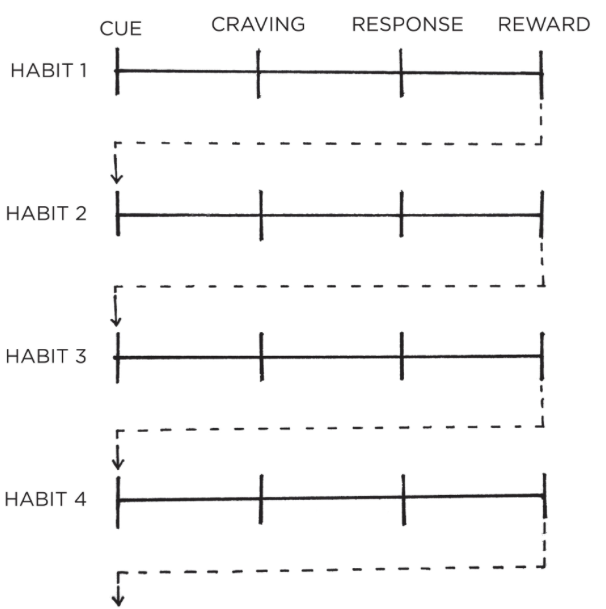
Example: Morning routine
- After I pour my morning cup of coffee, I will meditate for sixty seconds.
- After I meditate for sixty seconds, I will write my to-do list for the day.
- After I write my to-do list for the day, I will immediately begin my first task.
Example: Evening routine
- After I finish eating dinner, I will put my plate directly into the dishwasher.
- After I put my dishes away, I will immediately wipe down the counter.
- After I wipe down the counter, I will set out my coffee mug for tomorrow morning.
You can also insert new behaviors into the middle of your current routines.
Example
you may already have a morning routine that looks like this:
- Wake up
- Make my bed
- Take a shower
Let’s say you want to develop the habit of reading more each night. You can expand your habit stack and try something like
- Wake up
- Make my bed
- Place a book on my pillow
- Take a shower
Now, when you climb into bed each night, a book will be sitting there waiting for you to enjoy.
Habit stacking allows you to create a set of simple rules that guide your future behavior.
It’s like you always have a game plan for which action should come next.
Once you get comfortable with this approach, you can develop general habit stacks to guide you whenever the situation is appropriate.
Example
- Exercise. When I see a set of stairs, I will take them instead of using the elevator.
- Social skills. When I walk into a party, I will introduce myself to someone I don’t know yet.
- Finances. When I want to buy something over $100, I will wait twenty-four hours before purchasing.
- Healthy eating. When I serve myself a meal, I will always put veggies on my plate first.
- Minimalism. When I buy a new item, I will give something away. (“One in, one out.”)
- Mood. When the phone rings, I will take one deep breath and smile before answering.
- Forgetfulness. When I leave a public place, I will check the table and chairs to make sure I don’t leave anything behind.
The secret to creating a successful habit stack is selecting the right cue to kick things off.
Habit stacking implicitly has the time and location built into it. When and where you choose to insert a habit into your daily routine can make a big difference.
- Consider when you are most likely to be successful. Don’t ask yourself to do a habit when you’re likely to be occupied with something else.
Your cue should also have the same frequency as your desired habit.
How to find the right trigger for your habit stack?
Brainstorm a list of your current habits. Use your Habits Scorecard as a starting point. Or
The two-columns method
- Create a list with two columns
Habits you do each day without fail All of the things that happen to you each day without fail E.g. - Get out of bed.
- Take a shower.
- Brush your teeth.
- Get dressed.
- Brew a cup of coffee.
- Eat breakfast.
- Take the kids to school.
- Start the work day.
- Eat lunch.
- End the work day.
- Change out of work clothes.
- Sit down for dinner.
- Turn off the lights.
- Get into bed.
E.g. - The sun rises.
- You get a text message.
- The song you are listening to ends.
- The sun sets.
- Search for the best place to layer your new habit into your lifestyle
Habit stacking works best when the cue is highly specific and immediately actionable.
- Be specific and clear. E.g. After I close the door. After I brush my teeth. After I sit down at the table.
- The more tightly bound your new habit is to a specific cue, the better the odds are that you will notice when the time comes to act.
💡Take Away
The 1st Law of Behavior Change is make it obvious.
The two most common cues are time and location.
Creating an implementation intention is a strategy you can use to pair a new habit with a specific time and location.
- The implementation intention formula is: I will [BEHAVIOR] at [TIME] in [LOCATION].
Habit stacking is a strategy you can use to pair a new habit with a current habit.
- The habit stacking formula is: After [CURRENT HABIT], I will [NEW HABIT].
Motivation is Overrated; Environment Often Matters More
Environment is the invisible hand that shapes human behavior.
People often choose products not because of what they are, but because of where they are.
Example
ANNE THORNDIKE, A primary care physician at Massachusetts General Hospital in Boston, had a crazy idea. She believed she could improve the eating habits of thousands of hospital staff and visitors without changing their willpower or motivation in the slightest way. In fact, she didn’t plan on talking to them at all. Thorndike and her colleagues designed a six-month study to alter the “choice architecture” of the hospital cafeteria. They started by changing how drinks were arranged in the room. Originally, the refrigerators located next to the cash registers in the cafeteria were filled with only soda. The researchers added water as an option to each one. Additionally, they placed baskets of bottled water next to the food stations throughout the room. Soda was still in the primary refrigerators, but water was now available at all drink locations. Over the next three months, the number of soda sales at the hospital dropped by 11.4 percent. Meanwhile, sales of bottled water increased by 25.8 percent. They made similar adjustments—and saw similar results—with the food in the cafeteria. Nobody had said a word to anyone eating there.Your habits change depending on the room you are in and the cues in front of you.
- The most common form of change is not internal, but external: we are changed by the world around us.
- Every habit is context dependent.
Behavior is a function of the Person in their Environment, or $B = f (P, E)$ (Kurt Lewin Equation).
- The “Suggesting Impulse Buying” phenomenon - Customers will occasionally buy products not because they want them but because of how they are presented to them.
Example
Items at eye level tend to be purchased more than those down near the floor.
- For this reason, you’ll find expensive brand names featured in easy-to-reach locations on store shelves because they drive the most profit, while cheaper alternatives are tucked away in harder-to-reach spots.
- The same goes for end caps, which are the units at the end of aisles. End caps are moneymaking machines for retailers because they are obvious locations that encounter a lot of foot traffic. For example, 45 percent of Coca-Cola sales come specifically from end-of-the-aisle racks.
The more obviously available a product or service is, the more likely you are to try it.
Vision dominates human sensing.
- Visual cues powerfully trigger behavior.
- It is important to live and work in environments that are filled with productive cues and devoid of unproductive ones.
- You don’t have to be the victim of your environment. You can also be the architect of it! 💪
How to design your environment for success
Every habit is initiated by a cue, and we are more likely to notice cues that stand out.
When the cues that spark a habit are subtle or hidden, they are easy to ignore.
Example
- It’s easy not to practice the guitar when it’s tucked away in the closet.
- It’s easy not to read a book when the bookshelf is in the corner of the guest room.
- It’s easy not to take your vitamins when they are out of sight in the pantry.
Creating obvious visual cues can draw your attention toward a desired habit.
Example
Schiphol Airport urinals with fly stickers reduced cleaning costs by 8%.
Apples on the counter instead of fridge → more likely to eat them.
-> Redesign your environment and make the cues for your preferred habits more obvious
Example
- If you want to remember to take your medication each night, put your pill bottle directly next to the faucet on the bathroom counter.
- If you want to practice guitar more frequently, place your guitar stand in the middle of the living room.
- If you want to remember to send more thank-you notes, keep a stack of stationery on your desk.
- If you want to drink more water, fill up a few water bottles each morning and place them in common locations around the house.
If you want to make a habit a big part of your life, make the cue a big part of your environment.
- By sprinkling triggers throughout your surroundings, you increase the odds that you’ll think about your habit throughout the day.
- Make sure the best choice is the most obvious one. Making a better decision is easy and natural when the cues for good habits are right in front of you.
By environment design
- You can alter the spaces where you live and work to increase your exposure to positive cues and reduce your exposure to negative ones.
- Environment design allows you to take back control and become the architect of your life. Be the designer of your world and not merely the consumer of it.
The context is the cue
Over time, habits shift from being linked to specific cues to being tied to the whole context.
Example
- We mentally assign our habits to the locations in which they occur (home, office, gym, etc.).
- Each location develops a connection to certain habits and routines.
Our behavior is not defined by the objects in the environment but by our relationship to them.
- Stop thinking about your environment as filled with objects.
- Start thinking about it as filled with relationships. Think in terms of how you interact with the spaces around you.
Example
Different people can have different memories—and thus different habits—associated with the same place.
- For one person, her couch is the place where she reads for an hour each night.
- For someone else, the couch is where he watches television and eats a bowl of ice cream after work.
You can train yourself to link a particular habit with a particular context.
Habits can be easier to change in a new environment by removing or escaping from old cues.
It is easier to associate a new habit with a new context than to build a new habit in the face of competing cues.
Example
- It can be difficult to go to bed early if you watch television in your bedroom each night.
- It can be hard to study in the living room without getting distracted if that’s where you always play video games.
When you step outside your normal environment, you leave your behavioral biases behind. You aren’t battling old environmental cues, which allows new habits to form without interruption.
Example
- Want to think more creatively? Move to a bigger room, a rooftop patio, or a building with expansive architecture. Take a break from the space where you do your daily work, which is also linked to your current thought patterns.
- Trying to eat healthier? It is likely that you shop on autopilot at your regular supermarket. Try a new grocery store. You may find it easier to avoid unhealthy food when your brain doesn’t automatically know where it is located in the store.
When you can’t manage to get to an entirely new environment, redefine or rearrange your current one with “One space, one use”, separating work, relaxation, and sleep zones.
Avoid mixing the context of one habit with another!
When you start mixing contexts, you’ll start mixing habits—and the easier ones will usually win out.
Example
You can use your phone for all sorts of tasks, which makes it a powerful device. But when you can use your phone to do nearly anything, it becomes hard to associate it with one task. You want to be productive, but you’re also conditioned to browse social media, check email, and play video games whenever you open your phone.If your space is really limited, divide your room into activity zones (e.g., a chair for reading, a desk for writing, a table for eating.)
-> Sticking with this strategy, each context will become associated with a particular habit and mode of thought.
If you want behaviors that are stable and predictable, you need an environment that is stable and predictable. A stable environment where everything has a place and a purpose is an environment where habits can easily form.
💡Take Away
- Small changes in context can lead to large changes in behavior over time.
- Every habit is initiated by a cue. We are more likely to notice cues that stand out.
- Make the cues of good habits obvious in your environment.
- Gradually, your habits become associated not with a single trigger but with the entire context surrounding the behavior. The context becomes the cue.
- It is easier to build new habits in a new environment because you are not fighting against old cues.
The Secret to Self-Control
People with strong self-control are NOT inherently different from those who struggle.
- The key is structuring their environment to avoid constant temptations - They don’t rely on heroic willpower but rather minimize situations that require it.
- The people with the best self-control are typically the ones who need to use it the least.
- Long-term success comes from creating a disciplined environment, not just wishing for more discipline.
Habits in the brain:
Once encoded, they NEVER fully disappear!
Once encoded, the urge to act follows whenever the environmental cues reappear. If you’re not careful about cues, you can cause the very behavior you want to stop.
Example
- Shaming obese people with weight-loss presentations can make them feel stressed, and as a result many people return to their favorite coping strategy: overeating.
- Showing pictures of blackened lungs to smokers leads to higher levels of anxiety, which drives many people to reach for a cigarette.
Bad habits are autocatalytic: the process feeds itself and reinforce itself in a vicious cycle.
Example
Feeling bad → eat junk food → feel worse → eat more.
Watching TV → feel sluggish → watch more TV.
Health anxiety → smoke → worse health → more anxiety.
Researchers call this cue-induced wanting: external cues trigger automatic cravings.
-> Habit triggers work unconsciously and automatically, making bad habits self-perpetuating
In the short-run, you can choose to overpower temptation with willpower. But inn the long-run, we become a product of the environment that we live in.
-> A more reliable approach is to cut bad habit off at the source: Reduce exposure to the cue that causes it. Make it invisible!
Example
- If you can’t seem to get any work done, leave your phone in another room for a few hours.
- If you’re continually feeling like you’re not enough, stop following social media accounts that trigger jealousy and envy.
- If you’re wasting too much time watching television, move the TV out of the bedroom.
- If you’re spending too much money on electronics, quit reading reviews of the latest tech gear.
- If you’re playing too many video games, unplug the console and put it in a closet after each use.
This is simple but effective: Remove a single cue and the entire habit often fades away.
Secret to self-control: Make the cues of your good habits obvious and the cues of your bad habits invisible.
- Self-control is a short-term strategy, not a long-term one. You may be able to resist temptation once or twice, but it’s unlikely you can muster the willpower to override your desires every time.
- Instead of summoning a new dose of willpower whenever you want to do the right thing, your energy would be better spent optimizing your environment.
💡Take Away
- The inversion of the 1st Law of Behavior Change is make it invisible.
- Once a habit is formed, it is unlikely to be forgotten.
- People with high self-control tend to spend less time in tempting situations. It’s easier to avoid temptation than resist it.
- One of the most practical ways to eliminate a bad habit is to reduce exposure to the cue that causes it.
- Self-control is a short-term strategy, not a long-term one.