The 2nd Law - Make it Attractive
How to Maek a Habit Irresistible
Supernormal stimuli: a heightened version of reality
In animals
Exaggerated cues trigger stronger instinctive responses
Examples
Baby gulls peck harder at fake beaks with exaggerated red dots.
Geese roll back oversized objects like volleyballs as if they were eggs.
In humans
Examples
Junk food exaggerates natural cravings for salt, sugar, and fat.
Processed foods enhance orosensation and dynamic contrast (e.g., crunchy + creamy).
Food scientists optimize products to hit the bliss point → keep you eating more.
In modern society
Examples
Ads with photoshopped models → unrealistic beauty standards.
Social media → concentrated doses of likes and validation.
Pornography → artificially amplified stimulation.
Shopping environments → engineered cues to trigger desire.
Make use of Supernormal stimuli for habit forming: Make it attractive!
- The more attractive an opportunity is, the more likely it becomes habit-forming.
- While it is not possible to transform every habit into a supernormal stimulus, we can make any habit more enticing.
The Dopamine-driven feedback loop
Dopamine
- drives desire, not just pleasure. Without dopamine, animals “like” rewards but don’t “want” them → no action.
- fuels habits High-dopamine behaviors (junk food, gambling, social media, drugs) are the most addictive.
The dopamine-driven feedback loop:
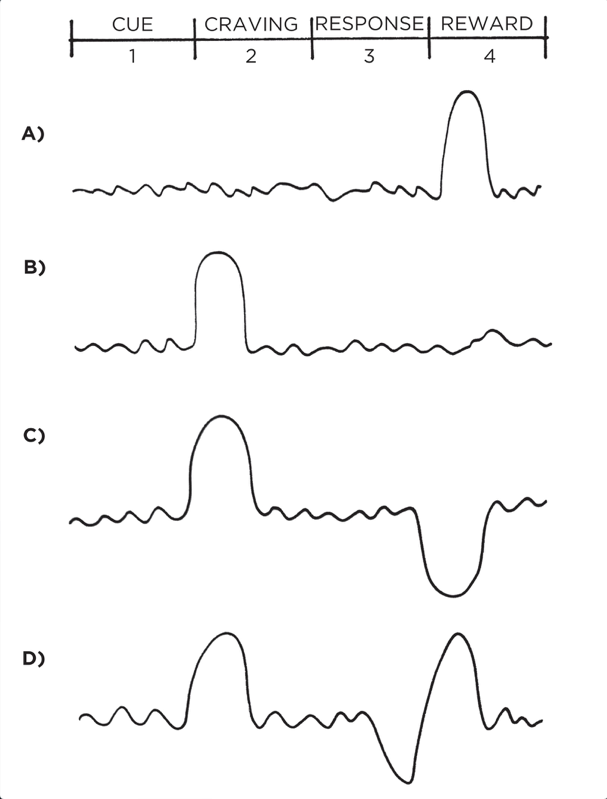
Before a habit is learned
- (A) dopamine is released when the reward is experienced for the first time.
- The next time around (B), dopamine rises before taking action, immediately after a cue is recognized. This spike leads to a feeling of desire and a craving to take action whenever the cue is spotted.
Once a habit is learned
- Dopamine will not rise when a reward is experienced because you already expect the reward. However, if you see a cue and expect a reward, but do not get one, then dopamine will drop in disappointment (C).
- The sensitivity of the dopamine response can clearly be seen when a reward is provided late (D).
- First, the cue is identified and dopamine rises as a craving builds.
- Next, a response is taken but the reward does not come as quickly as expected and dopamine begins to drop.
- Finally, when the reward comes a little later than you had hoped, dopamine spikes again. It is as if the brain is saying, “See! I knew I was right. Don’t forget to repeat this action next time.”
Anticipation matters more than reward
Dopamine spikes when expecting a reward, not just after receiving it.
Example
Gambling addicts have a dopamine spike right before they place a bet, not after they win.
Cocaine addicts get a surge of dopamine when they see the powder, not after they take it.
Whenever you predict that an opportunity will be rewarding, your levels of dopamine spike in anticipation. And whenever dopamine rises, so does your motivation to act.
“Wanting” vs. “liking”: It is the anticipation of a reward—not the fulfillment of it—that gets us to take action.
- The reward system that is activated in the brain when you receive a reward is the same system that is activated when you anticipate a reward.
- Your brain has far more neural circuitry allocated for wanting rewards than for liking them.
- 100 percent of the nucleus accumbens is activated during wanting, while only 10 percent of the structure is activated during liking.
Example
- As a child, thinking about Christmas morning can be better than opening the gifts.
- As an adult, daydreaming about an upcoming vacation can be more enjoyable than actually being on vacation.
Desire is the engine that drives behavior. Every action is taken because of the anticipation that precedes it. It is the craving that leads to the response.
-> For habits, we need to make our habits attractive because it is the expectation of a rewarding experience that motivates us to act in the first place.
Use temptation bundling to make your habits more attractive
Temptation bundling: Link an action you want to do with an action you need to do.
- You’re more likely to find a behavior attractive if you get to do one of your favorite things at the same time.
- Temptation bundling is one way to apply a psychology theory known as Premack’s Principle - “More probable behaviors will reinforce less probable behaviors.”.
- Temptation bundling is one way to create a heightened version of any habit by connecting it with something you already want.
Combine Habit Stacking and Temptation Bundling:
After [CURRENT HABIT], I will [HABIT I NEED].After [HABIT I NEED], I will [HABIT I WANT].
Example
If you want to read the news, but you need to express more gratitude:
- After I get my morning coffee, I will say one thing I’m grateful for that happened yesterday (need).
- After I say one thing I’m grateful for, I will read the news (want).
If you want to watch sports, but you need to make sales calls:
- After I get back from my lunch break, I will call three potential clients (need).
- After I call three potential clients, I will check ESPN (want).
If you want to check Facebook, but you need to exercise more:
- After I pull out my phone, I will do ten burpees (need).
- After I do ten burpees, I will check Facebook (want).
💡Take Away
- The 2nd Law of Behavior Change is make it attractive.
- The more attractive an opportunity is, the more likely it is to become habit-forming.
- Habits are a dopamine-driven feedback loop. When dopamine rises, so does our motivation to act.
- It is the anticipation of a reward—not the fulfillment of it—that gets us to take action. The greater the anticipation, the greater the dopamine spike.
- Temptation bundling is one way to make your habits more attractive. The strategy is to pair an action you want to do with an action you need to do.
The Role of Family and Friends in Shaping Your Habits
The seductive pull of social norms
Humans are herd animals with a deep desire to belong, connect, and gain peer approval.
Early habits are usually not chosen by ourselve, but mostly imitated from family, friends, schools, communities, and society.
Social norms act as invisible rules guiding daily behavior, often unconsciously.
Behaviors become attractive when they help us fit in with the group.
Example
- If you grow up in a family that rewards you for your chess skills, playing chess will seem like a very attractive thing to do.
- If you work in a job where everyone wears expensive suits, then you’ll be inclined to splurge on one as well.
- If all of your friends are sharing an inside joke or using a new phrase, you’ll want to do it, too, so they know that you “get it.”
We imitate the habits of three groups in particular:
The close
The many
The powerful
Imitating the close
Proximity has a powerful effect on our behavior.
We pick up habits from the people around us, usually without realizing it.
Example
- We copy the way our parents handle arguments, the way our peers flirt with one another, the way our coworkers get results.
- When your friends smoke pot, you give it a try, too.
- When your wife has a habit of double-checking that the door is locked before going to bed, you pick it up as well.
-> A general rule: The closer we are to someone, the more likely we are to imitate some of their habits.
Peer pressure can be positive or negative, depending on who surrounds you.
One of the most effective way to build habits: **Join a culture where **
your desired behavior is the normal behavior.
New habits seem achievable when you see others doing them every day.
Your culture sets your expectation for what is “normal.” Surround yourself with people who have the habits you want to have yourself so you’ll rise together. 💪
you already have something in common with the group
- Belonging transforms “personal quest” into shared identity
- Growth and change is no longer an individual pursuit. The shared identity begins to reinforce your personal identity.
- Staying in the group after reaching your goal is key to sustaining habits long-term - It’s friendship and community that embed a new identity and help behaviors last over the long run.
- Belonging transforms “personal quest” into shared identity
####Imitating the many
Humans naturally check group behavior when uncertain, seeking social validation.
Conformity has pros and cons
- Pros: Usually a smart, safe, energy-saving strategy
- Cons: The normal behavior of the tribe often overpowers the desired behavior of the individual.
There is tremendous internal pressure to comply with the norms of the group.
- The reward of being accepted is often greater than the reward of winning an argument, looking smart, or finding truth. Most days, we’d rather be wrong with the crowd than be right by ourselves.
- The human mind knows how to get along with others. It wants to get along with others. This is our natural mode.
Habit insights:
- When changing your habits means challenging the tribe, change is unattractive.
- When changing your habits means fitting in with the tribe, change is very attractive.
Imitating the powerful
Humans seek power, prestige, and status because they bring resources, security, and attractiveness.
We are drawn to behaviors that earn us respect, approval, admiration, and status.
Example
We want to be the one in the gym who can do muscle-ups or the musician who can play the hardest chord progressions or the parent with the most accomplished children because these things separate us from the crowd.Once we fit in, we start looking for ways to stand out.
We imitate/copy successful/high-status people’s habits, hoping to gain similar success.
Example
- You replicate the marketing strategies of the most successful firms in your industry.
- You make a recipe from your favorite baker.
- You borrow the storytelling strategies of your favorite writer.
- You mimic the communication style of your boss.
We also avoid behaviors that lower our status.
Example
- We trim our hedges and mow our lawn because we don’t want to be the slob of the neighborhood.
- When our mother comes to visit, we clean up the house because we don’t want to be judged.
💡Take Away
- The culture we live in determines which behaviors are attractive to us.
- We tend to adopt habits that are praised and approved of by our culture because we have a strong desire to fit in and belong to the tribe.
- We tend to imitate the habits of three social groups:
- the close (family and friends),
- the many (the tribe), and
- the powerful (those with status and prestige).
- One of the most effective things you can do to build better habits is to join a culture where
- your desired behavior is the normal behavior, and
- you already have something in common with the group.
- The normal behavior of the tribe often overpowers the desired behavior of the individual. Most days, we’d rather be wrong with the crowd than be right by ourselves.
- If a behavior can get us approval, respect, and praise, we find it attractive.
How to Find and Fix the Causes of Your Bad Habits
Where cravings come from
####The underlying motive
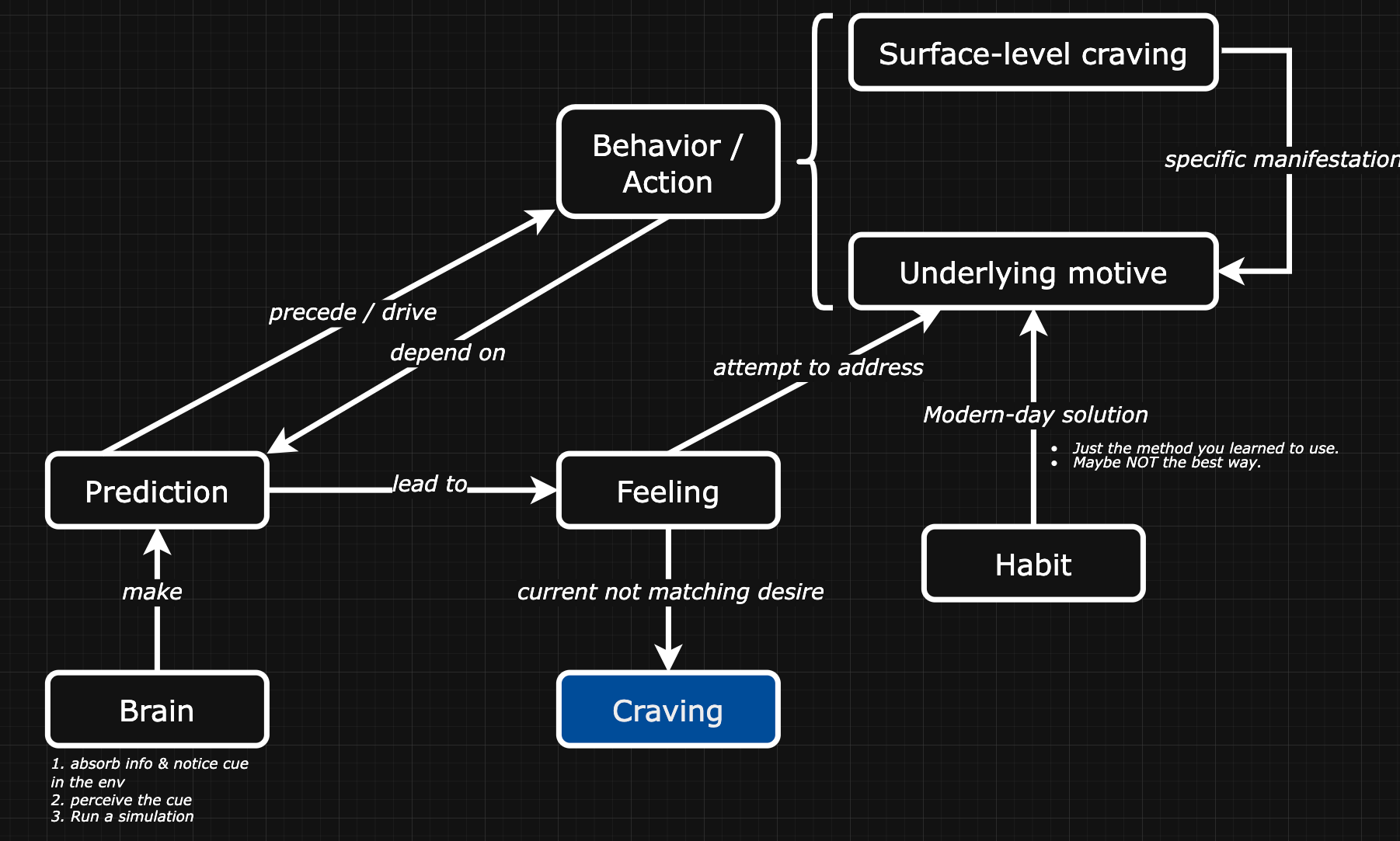
Every behavior has two layers
- a surface level craving (what you consciously want)
- a deeper, underlying motive (what your brain truly seeks)
Some of our underlying motives include:
- Conserve energy
- Obtain food and water
- Find love and reproduce
- Connect and bond with others
- Win social acceptance and approval
- Reduce uncertainty
- Achieve status and prestige
A craving is just a specific manifestation of a deeper underlying motive.
Example
Habits = mordern-day solutions to ancient desires
| Underlying motive | Mordern-day solution |
|---|---|
| Find love and reproduce | using Tinder |
| Connect and bond with others | browsing Facebook |
| Win social acceptance and approval | posting on Instagram |
| Reduce uncertainty | searching on Google |
| Achieve status and prestige | playing video games |
There are many different ways to address the same underlying motive.
- E.g.: To release stress, somebody smokes a cigarett, while another go for a run.
- Your current habits are not necessarily the best way to solve the problems you face; they are just the methods you learned to use. Once you associate a solution with the problem you need to solve, you keep coming back to it.
Habits are predictive.
Habits are all about associations, which determine whether we predict a habit to be worth repeating or not.
Your brain is continually absorbing information and noticing cues in the environment.
Every time you perceive a cue, your brain runs a simulation and makes a prediction about what to do in the next moment.
Example
- Cue: You notice that the stove is hot. Prediction: If I touch it I’ll get burned, so I should avoid touching it.
- Cue: You see that the traffic light turned green. Prediction: If I step on the gas, I’ll make it safely through the intersection and get closer to my destination, so I should step on the gas.
This all happens in an instant, but it plays a crucial role in your habits because every action is preceded by a prediction.
- All day long, you are making your best guess of how to act given what you’ve just seen and what has worked for you in the past. You are endlessly predicting what will happen in the next moment.
Our behavior is heavily dependent on these predictions.
Our behavior is heavily dependent on how we interpret the events that happen to us, not necessarily the objective reality of the events themselves.
The same cue can spark a good habit or a bad habit depending on your prediction. The cause of your habits is actually the prediction that precedes them.
Example
Two people can look at the same cigarette, and one feels the urge to smoke while the other is repulsed by the smell.
These predictions lead to feelings (a craving / a feeling / a desire / an urge ), which transform the cues we perceive and the predictions we make into a signal that we can apply.
Craving
A craving is the sense that something is missing. It is the desire to change your internal state.
Example: When the temperature falls, there is a gap between what your body is currently sensing and what it wants to be sensing. This gap between your current state and your desired state provides a reason to act.
Desire
Our feelings and emotions tell us whether to hold steady in our current state or to make a change. They help us decide the best course of action.
💡Summary
- The specific cravings you feel and habits you perform are really an attempt to address your fundamental underlying motives.
- Habits are attractive when we associate them with positive feelings, and we can use this insight to our advantage rather than to our detriment.
Example
When someone decides to “go to the gym,” it may look like a simple behavior, but behind it lies a whole psychological and habitual mechanism.
At first, this person wants to have a better body, look more attractive, or improve health and energy (surface-level craving). These are the obvious, conscious reasons that motivate the action.
But underneath that craving lies a deeper underlying motive, such as:
- The need for recognition or social belonging.
- The desire to feel in control of one’s life.
- The motivation to stay healthy and live longer.
These motives represent basic human needs, expressed through the act of going to the gym.
Over time, the person forms associations with the gym environment:
- The smell of the gym, the sound of weights clanking, and the upbeat music all become cues linked to discipline and progress.
- Putting on workout clothes or packing a gym bag triggers the mental state of “I’m ready to work out.”
These associations help the brain form predictions about what will happen next:
“Once I start sweating, I’ll feel accomplished.”
“Finishing a training session could improve my sport performance, and make my body stronger and look better.”
“After training, I’ll be tired but relaxed and sleep better.”
When these predictions are repeatedly proven true, the brain connects exercise with positive feelings. The dopamine released during workouts creates satisfaction and pleasure, reinforcing the desire to repeat the behavior.
Gradually, this behavior evolves into a habit. What once required effort and planning becomes automatic — seeing the gym bag or hearing workout music instantly puts the person in “training mode.” The shift from wanting to go to naturally going is complete.
| Element | Explanation | Example in Context (Gym) |
|---|---|---|
| Behavior | The observable action performed repeatedly. | Going to the gym regularly. |
| Surface-Level Craving | The immediate, conscious desire that motivates the action. | Wanting a fit body, better health, or more energy. |
| Underlying Motive | The deeper psychological or emotional reason behind the craving. | Seeking recognition, self-control, or overall well-being. |
| Associations | Environmental or sensory cues linked to the behavior. | Gym music, smell, or putting on workout clothes trigger “training mode.” |
| Prediction | The brain’s expectation of what the behavior will lead to. | “I’ll feel accomplished and relaxed after the workout.” |
| Feeling | The emotional and chemical feedback reinforcing the behavior. | Dopamine release and satisfaction after training. |
| Habit | When the behavior becomes automatic through repetition. | Going to the gym without overthinking; it’s part of daily routine. |
Explanation (CN)
🧠 中文详解(含生活例子)
这段文字的核心思想是: 👉 我们表面上的“渴望”其实只是更深层动机的一种表现形式。
一、表层渴望 vs. 深层动机
- 当你觉得“我想吃塔可”时,看似是一个具体的渴望。 但在更深层,你的身体其实是出于“生存”的动机——为了获取能量(食物与水)。
- 所以,所有的习惯、欲望、行为,都不是凭空出现的,它们都源自一些根本的人类动机,例如:
- 节省能量(Conserve energy)
- 获得食物与水(Obtain food and water)
- 寻求爱与繁衍(Find love and reproduce)
- 连接与归属(Connect and bond with others)
- 赢得社会认可与赞同(Win social acceptance and approval)
- 降低不确定性(Reduce uncertainty)
- 获得地位与声望(Achieve status and prestige)
📍 举个例子: 你刷Instagram,看似是为了“娱乐”或“看朋友动态”, 其实深层动机是——想要连接他人、获得认可、被赞赏。 这与原始人类渴望成为“部落中受欢迎的一员”是同一种心理机制。
二、现代习惯 = 旧动机的新形式
书中说:“你的习惯是古老欲望的现代版本(modern-day solutions to ancient desires)。” 也就是说,我们今天的各种行为,其实是在用现代的方式解决远古人类的根本需求。
| 深层动机 | 现代行为 |
|---|---|
| 寻求爱与繁衍 | 用 Tinder 交友 |
| 建立连接与关系 | 浏览 Facebook |
| 追求社会认同 | 在 Instagram 发帖 |
| 降低不确定性 | 搜索 Google |
| 追求地位 | 打游戏、升级、排名 |
📍 例子: 你打开Google不是“随机行为”,而是大脑想要减少未知、缓解焦虑的体现。 你打游戏赢了、升了段位,是在满足“获得地位”的底层欲望。
三、同一个动机有不同的“解法”
- 不同的人会用不同方式去满足同一个底层动机。
比如:
- 有人缓解焦虑靠抽烟;
- 有人靠跑步;
- 有人靠冥想。
- 这说明:你现在的习惯不一定是最优解,只是你曾经学到的那种解决方式。 一旦你的大脑把“某种行为”与“某个需求”联系起来,它就会不断重复。
📍 例子: 你下班后看剧,是因为大脑学会了“看剧=放松”。 但其实你也可以通过“散步”或“泡热水澡”获得同样的放松感。 要改变习惯,关键是改变你对哪种行为能带来好感受的“联想”。
四、预测与感受是习惯的核心机制
- 每个行为背后都包含一个“预测”(prediction)。
- 当你看到某个提示(cue),大脑立刻预测:“我这么做会发生什么?”
例如:
- 看到红灯变绿 → 预测:现在可以安全通过 → 开车前进
- 看到香烟 → 预测:抽一根能放松 → 点燃香烟
- 也就是说:习惯不是对现实反应,而是对大脑的预测反应。
📍 举个例子: 两个人都看到一根香烟,一个人想抽,一个人觉得恶心。 区别不在香烟本身,而在他们的大脑预测的“结果”不同。 这说明:同样的提示,不同的预测 → 不同的习惯。
五、情绪是行动信号(Emotion = Action signal)
- 情绪告诉我们:该维持当前状态,还是做出改变。
- 当你感到冷,就是身体预测“加件衣服会更舒服” → 行动。
- 渴望(craving)本质上就是:你感到现在和理想状态之间有“差距”,想要弥补它。 → “渴望 = 想让自己感觉不一样”。
📍 举个例子: 你无聊时刷手机,不是因为真的想看内容,而是因为你想“改变当前的情绪状态”(无聊 → 有趣)。 这也是为什么很多坏习惯根源在“情绪逃避”。
六、总结思想
👉 我们的习惯其实是:
- 大脑在不断预测并选择行为,
- 来满足某种根本的人类动机,
- 并且强化与“好感受”相关的行为。
一旦某个习惯成功带来了正向感受,我们的大脑就会“学会”并重复它。 这也是为什么坏习惯容易形成——因为它们立刻带来好感受(尽管长期有害)。 理解这一点后,我们就能有意识地重新定义“哪种行为”能带来满足感,从而建立更好的习惯。
How to reprogram your brain to enjoy hard habits
Mindset shift
You can make hard habits more attractive if you can learn to associate them with a positive experience - a mindset shift from burden to opportunity: “Have to” → “Get to”.
Example: Replace “I have to” with “I get to” to reframe daily tasks.
| Have to | Get to |
|---|---|
| You have to wake up early for work. | You get to wake up early for work. |
| You have to make another sales call for your business. | You get to make another sales call for your business. |
| You have to cook dinner for your family. | You get to cook dinner for your family. |
Reframing habits
Reframing your habits to highlight their benefits rather than their drawbacks is a fast and lightweight way to reprogram your mind and make a habit seem more attractive.
Examples:
Exercise
Finance
Mediation
Pregame jitters
Motivation Rituals
Associate your habits with something you enjoy, then you can use that cue whenever you need a bit of motivation.
Example
A writer puts on headphones → instantly enters “focus mode.”
An athlete performs a fixed warm-up → triggers “competition mindset.”
You can adapt this strategy for nearly any purpose.
Example
Say you want to feel happier in general. Find something that makes you truly happy—like petting your dog or taking a bubble bath—and then create a short routine that you perform every time before you do the thing you love. Maybe you take three deep breaths and smile.
Three deep breaths. Smile. Pet the dog. Repeat.
Eventually, you’ll begin to associate this breathe-and-smile routine with being in a good mood. It becomes a cue that means feeling happy. Once established, you can break it out anytime you need to change your emotional state.
- Stressed at work? Take three deep breaths and smile.
- Sad about life? Three deep breaths and smile.
Once a habit has been built, the cue can prompt a craving, even if it has little to do with the original situation.
The key to finding and fixing the causes of your bad habits is to reframe the associations you have about them. It’s not easy, but if you can reprogram your predictions, you can transform a hard habit into an attractive one.
💡Take Away
- The inversion of the 2nd Law of Behavior Change is make it unattractive.
- Every behavior has a surface level craving and a deeper underlying motive.
- Your habits are modern-day solutions to ancient desires.
- The cause of your habits is actually the prediction that precedes them. The prediction leads to a feeling.
- Highlight the benefits of avoiding a bad habit to make it seem unattractive.
- Habits are attractive when we associate them with positive feelings and unattractive when we associate them with negative feelings. Create a motivation ritual by doing something you enjoy immediately before a difficult habit.